Subscriber Discussion Forum:
FabTime Newsletter, Volume 27, No 1
We have subscriber discussion about our cycle time improvement process and the Waddington Effect.
Extension to our three-step process for improving wafer fab cycle time: an optional fourth step about explaining what you’re learned to others
I was reading an article recently by Arthur Brooks. A prescription for happiness that Brooks included struck me. He said (emphasis mine): “To get enduringly happier, you need to understand the science, change your habits and behavior in tangible ways, and explain what you have learned to others.”
This reminded me of the newsletter article that I published in Issue 26.01: Why and How Fabs Should Focus on CT Improvement. I proposed that to improve fab cycle time, people need to understand the fundamentals of factory behavior, collect actual data on where the problems are, and change behaviors in the factory. The first and third of these match Brooks’ prescription (understanding the science and making changes in behavior). I added a recommendation for data collection that Brooks didn’t mention. My three-step process for cycle time improvement didn’t include Brooks’ final point about being able to explain what you have learned to others, but I think that could be a useful optional fourth step.
There are two ways to think about sharing your learning with others in the context of fab cycle time improvement. First, participating in a fab cycle time improvement class or reading these newsletters or other resources can increase understanding. But the best way to know that you really understand something is to be able to teach it to someone else. For me, the process of writing the newsletter and teaching cycle time classes helps me to better understand each topic that I cover. It’s easy to gloss over in my own mind when I kind of grasp something. But to share it with someone else, I have to really dig into it and understand it at another level. This is true for factory physics or anything else one learns about. If you try teaching someone else about what you’ve learned, you’ll help them and enhance your own understanding.
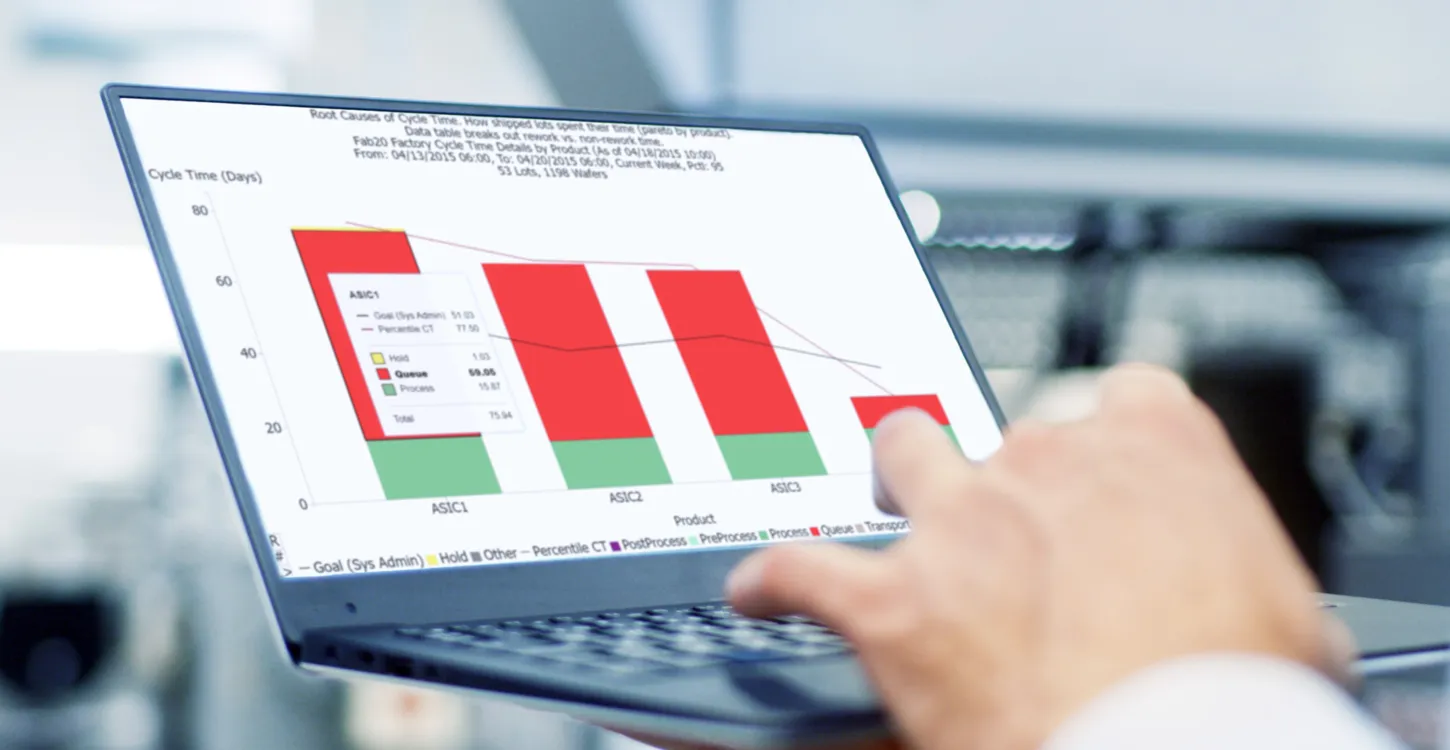
Also, in the context of fab operations, it’s difficult, perhaps impossible, to explain what you’ve learned to others unless you have some sort of images to show. This is probably true for anything complex. I recommend leaning on graphs or other images when you do teach people things. I think this is a real benefit of FabTime and Factory Dashboard: you don’t just get a set of numbers telling you what’s happening. You get graphs that can help you to convey as much information to others as possible.
So, to improve your fab operations, I now recommend that you:
- Learn about the fundamentals of fab behavior.
- Collect actual data to see where the current problems lie.
- Take action to change behavior in the fab.
- Teach steps 1 to 3 to others in your organization.
Let me know how that works out for you!


The Waddington Effect on small general aviation airplanes
Back in Issue 25.06, we wrote about the Waddington Effect, which found that (according to research on bombers in World War II) unscheduled downtime events increase for a time after scheduled maintenance, rather than decreasing. We thought that readers would be interested to learn about a more recent study that observed the same effect in small general aviation (GA) airplanes. A November 2025 article on the Savvy Aviation website describes and links to a pre-print of the study by Daniele Paolo Scarpazza and Joseph A. Hutter. (Thank you to Frank Chance for the link.)
Per Savvy Aviation, “(t)he analysis found that during the first hour after a piston GA airplane flies after its annual or 100-hour inspection, it is 33.8 percent more likely to have an aircraft-caused accident or serious incident than the human-caused event baseline. This declines to 30.0 percent during the second hour, 27.5 percent during the third hour—sure sounds like the Waddington effect, doesn’t it? —and continues to decline hour-by-hour until the risk of aircraft-caused and human-caused events becomes equal after 31 hours TSLI.” The author concludes that if the analysis is correct, the FAA’s mandated 100-hour inspections for GA airplanes may well be causing more harm than good.
Further Reading
Past issues of the newsletter are available for subscribers to download in PDF format. Existing subscribers can find the archive link in your most recent email newsletter. New subscribers will see the link upon registering.
- Register for the newsletter here.
- Main article for Volume 27, No. 1: Fab Trade-Offs: Better Cycle Time for the Status Quo
- FabTime Newsletter Community Announcements Page