Sustainability
A Core Aspect of our Business
As a global leader in instruments for gas analysis, measurement and control, INFICON's business model is backed by our commitment to do business sustainably in economic, environmental and social terms, as well as regarding governance and leadership.
INFICON's approach to sustainability is comprehensive and holistic. In our business decisions and conduct, we consider economic, environmental and social aspects at both strategic and operational levels.
Our emphasis on sustainability provides guidelines for INFICON’s customer-oriented innovation management, its worldwide purchasing and production processes, its risk management, as well as the conduct of its customer relations.

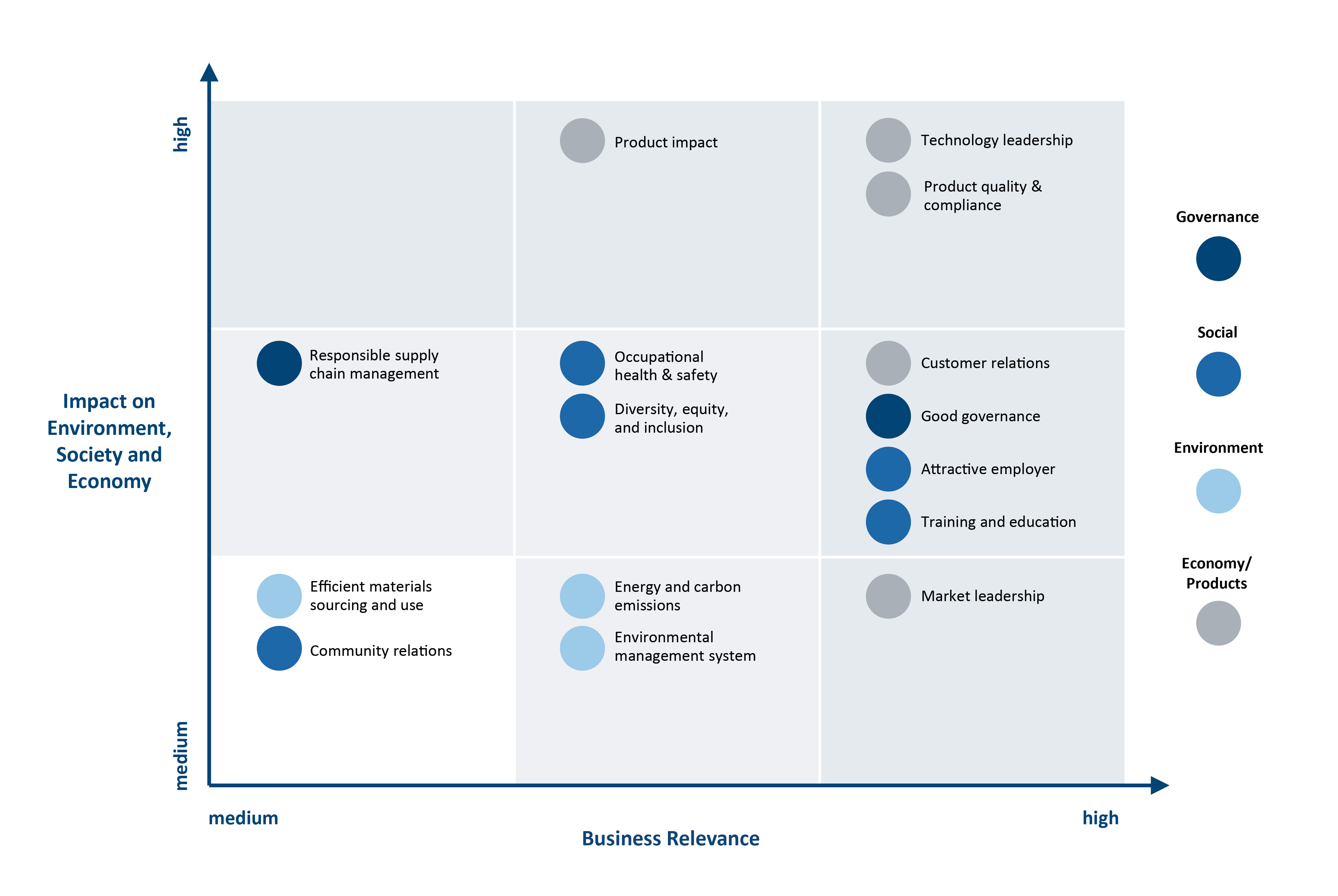
Materiality Matrix
We consider topics as material that are important to INFICON regarding their business relevance, and/or have a significant economic, environmental, or social impact. The materiality matrix below thus shows and prioritizes the identified topics. In the review year, the topics and their positioning in the matrix were reviewed and confirmed by the Members of the Board of Directors.

We remain committed to reducing our environmental footprint and creating long-term value for all stakeholders.

96% in 2024 (Decrease resulting from limited access to green electricity at one of our specialized competence centers.)


to 2.053 T CO2 in 2025

is used as energy carrier

Car policy prioritizing EVs and plug-in hybrids; expansion of e-charging stations. 41 e-charging stations added since 2020

Re-use, Refurbish, Repair of material—from office furniture to advanced instrumentation

Optimizing building and production infrastructure (e.g., renewable energy, use of solar, automated lighting and heating)