Methane Emissions Monitored Fast and Digitally for Rapid On-Site Gas Analysis
A global methane emissions monitoring specialist speeds up inspections and improves data reporting using innovative infrared technology.

Inspection service company Intero - The Sniffers, with branch offices worldwide, operates a range of technologies to detect and prevent gas leaks in major installations.
The company works with major oil and gas companies, such as Total, Shell, and Aramco. In the past two years, Intero has seen significantly increased business from the gas sector, due to a rise in demand for monitoring methane emissions.
Intero uses a range of technologies to detect gas leaks, including laser and infrared instruments. “For detecting methane emissions the sector is changing to laser and infrared. These instruments are easier to work with than other technologies,” says Bas Hermans, Operations Director at Intero - The Sniffers.
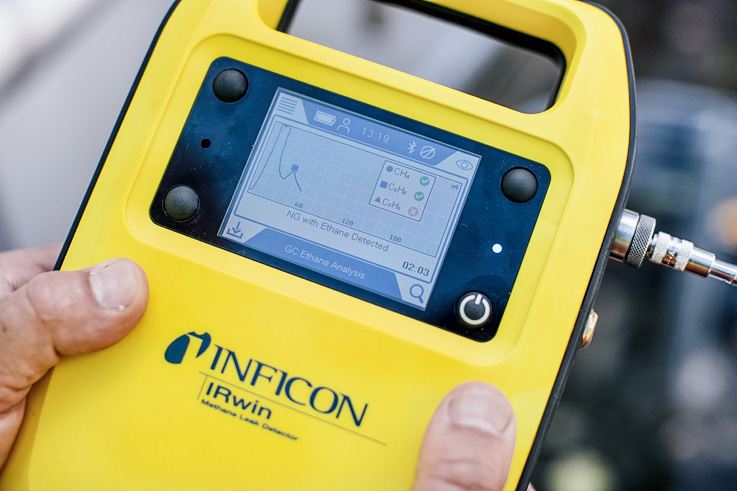
One of the instruments used in the field is the IRwin Methane Leak Detector from INFICON, which offers advanced capabilities that simplify leak detection and data management.
Innovative Technology for On-Site Gas Analysis
The IRwin Methane Leak Detector stands out for its ability to quickly analyze gas on-site and provide detailed constituent readings. Unlike some laser instruments that only detect the presence of gas, the IRwin device calculates the individual fractions of methane, propane, and ethane—key components of natural gas.
“We also use laser instruments, but they can only detect whether gas is present, not the constituent parts. Methane makes up over 90% of the volume of natural gas, but some clients also want to see propane and ethane, which make up about 4% and 2%, respectively. You get this from the IR instrument, which calculates and displays the different fractions,” explains Hermans.

Digitalization Enhances Efficiency
One of the major advantages of the IRwin instrument is its Bluetooth® connectivity, which allows integration with Intero’s own software platform. This feature enables rapid data logging and automatic uploading of survey results, greatly simplifying record-keeping and data sharing.
The IRwin App further enhances collaboration by enabling easy sharing of leak detection results with clients and team members in real time. Field engineers can create and send reports directly from the site in just a few seconds, saving hours of administrative work. This not only improves accuracy but also ensures that survey data and leak findings are securely stored, organized, and available for immediate client reporting.
But the benefits of digitalization go even further. The entire inspection route is automatically tracked using a built-in GPS, which seamlessly integrates with GIS systems for easy mapping and verification. All survey data are transferred wirelessly via Bluetooth to a smartphone, tablet, or computer—no cables, no manual note-taking, and no risk of data loss.
By digitizing the entire workflow—from detection to documentation—Intero achieves faster leak surveys, higher data reliability, and streamlined communication between field technicians and clients.
Safer and More Reliable Leak Detection
Intero’s previous reliance on flame ionization detectors (FID) and semiconductor sensors posed challenges. While flame ionization detection has been one of the most widely used gas detection methods in recent decades, it is now increasingly being replaced by more modern and efficient technologies.
The FID system operates by burning a small hydrogen flame to ionize gas molecules—a process that, while accurate, introduces practical and safety challenges. Because hydrogen itself is an explosive gas, the use of FID instruments is heavily restricted in hazardous or explosive (Ex) environments, which are common in oil and gas facilities. This limitation often complicates field operations and requires additional safety precautions.
“The FID instruments use hydrogen, which is in itself an explosive gas, so this caused a lot of restrictions when working offshore in the oil and gas industry. The infrared instrument can be used in explosive environments without problem and without a carrier gas,” Hermans notes.
In addition to safety constraints, FID instruments typically have an upper measurement limit of around 10,000 to 100,000 ppm, which can be a limitation in certain applications. Infrared instruments, by contrast, can measure gas concentrations across the complete range, offering greater flexibility. Combined with the fact that traditional FID equipment tends to be heavy and cumbersome—reducing operator efficiency during long field deployments—this has driven the industry’s shift toward digital, safer, and more efficient infrared solutions, which are increasingly becoming the new standard for leak detection in the field.
Growing Demand for Methane Monitoring
In the past, the main focus was on leak detection in chemical plants and refineries, for which Intero frequently used flame ionization detectors to detect gas at close range. As the focus is more on natural gas these days, the technologies are shifting.
Intero - The Sniffers continues to lead the way in methane leak detection, combining cutting-edge technology with digital innovation to provide fast, accurate, and user-friendly solutions for clients worldwide.


Curious how on-site gas analysis can be faster and more accurate?
Explore the IRwin Methane Leak Detector and its features on the product page.