INFICON Technology Returning to the Moon
Transpector® MPH will map water and volatiles at the Lunar South Pole to guide future astronaut landings.

Fresh off its historic 2025 lunar landing anniversary, INFICON technology will return to the Moon for a fifth mission in 2030 to help pinpoint future astronaut landing sites at the Lunar South Pole.
Through NASA’s Commercial Lunar Payload Services (CLPS) initiative and Artemis program, the Intuitive Machines IM-5 lander will deliver NASA's MSolo instrument to the lunar surface. At the heart of MSolo (Mass Spectrometer Observing Lunar Operations) is the INFICON Transpector® MPH, a commercial off-the-shelf quadrupole mass spectrometer ruggedized for the lunar environment. By measuring water and volatile compounds at the lunar surface, Transpector MPH generates critical data that will help guide where future astronauts land and sustain a human presence.
Transpector MPH successfully demonstrated its gas analysis capabilities during Intuitive Machines’ IM-2 lunar mission in March 2025, the southernmost Moon landing in history. This marked a significant leap in the use of commercial off-the-shelf technology for space missions.

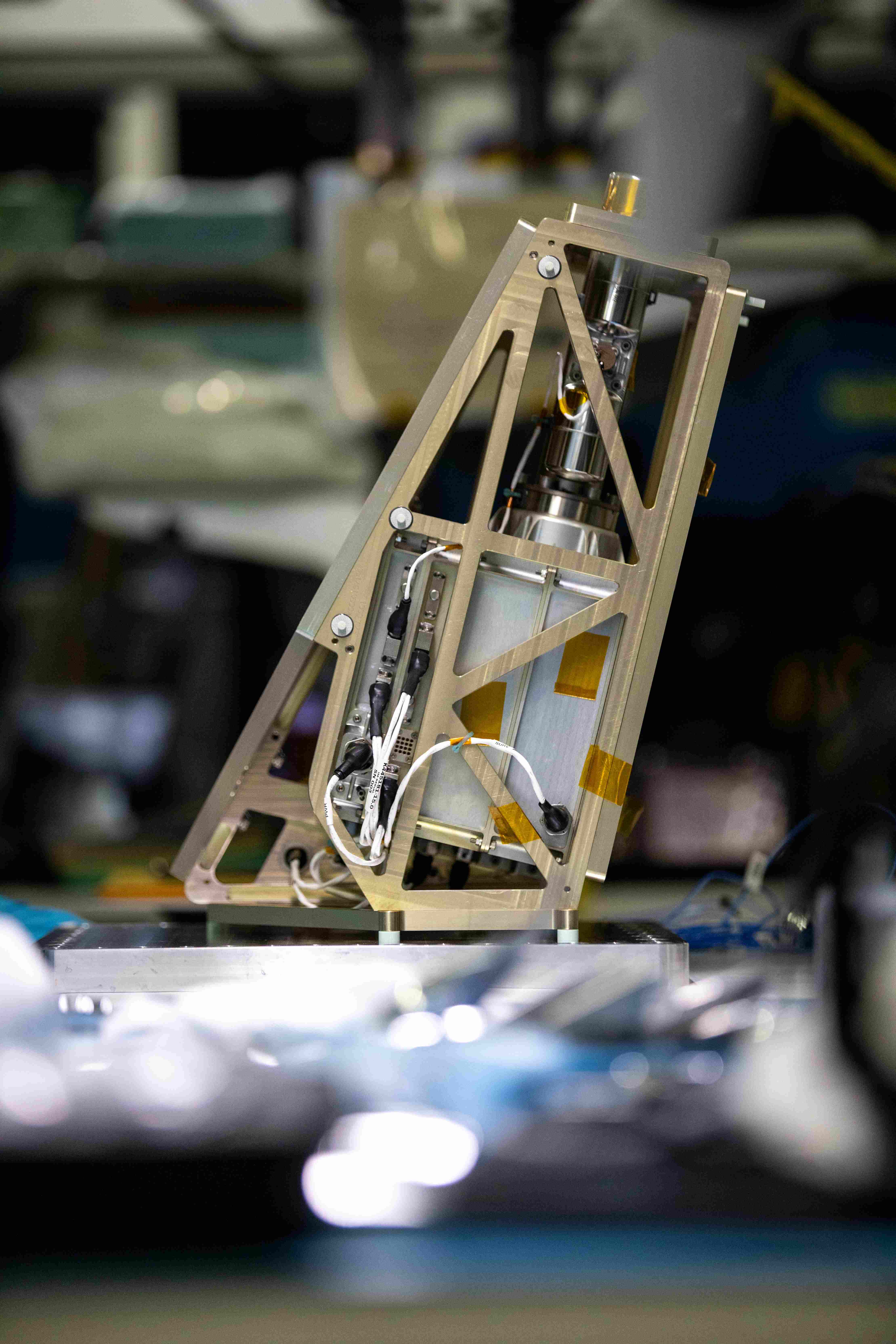
Dr. Andres Diaz, Applications Research Lead for Emerging Technologies & New Markets working with INFICON, explained that with MSolo and INFICON’s Transpector MPH, there is a real opportunity to characterize where resources exist to give space mission planners the data they need to sustain human presence safely in such a harsh and remote environment.
“We are proud to enable space exploration and look forward to collaborating more closely with Kennedy Space Center and space companies like Intuitive Machines on this NASA mission and future ones,” he said. "This is exactly the kind of work that makes our careers meaningful and exciting."
IM-5 is a significant mission expansion, using a larger lander that can carry seven total payloads and targets Mons Malapert, a ridge near the Lunar South Pole that offers continuous Earth visibility and access to permanently shadowed regions. The data it generates will help determine where astronauts can safely and sustainably land.
This mission builds on more than 14 years of collaboration between INFICON and NASA's Kennedy Space Center. In preparation for 2030, INFICON remains focused on contributing to the exploration and understanding of space.
“Space exploration is becoming more commercially accessible, and INFICON is at the forefront of that shift. The fact that our technology has been selected for a fifth lunar mission by NASA is a testament to the team that has spent years making this possible. It also speaks to what INFICON instrumentation can do in the most demanding environment imaginable,” said Hannah Henley, President, Intelligent Sensor Solutions, INFICON.
As the Artemis program advances toward returning humans to the Moon, INFICON remains committed to the exploration and understanding of space, and to the partnerships that make it possible.


